
Don’t Start Building IT Infrastructure from Scratch Until You Read This
Discover how Saudi businesses can build resilient, secure, and AI-ready IT infrastructure. Learn key mistakes to avoid, best practices, and future trends aligned with Vision 2030.
Asyar-team
In Saudi Arabia, the push for digital transformation requires businesses of all sizes to start building IT infrastructure from scratch.
However, over 60% of global digital infrastructure failures still cost at least $100,000 per incident, with almost 15% exceeding $1 million.
The challenges are only increasing. Factors such as remote work, surging data volumes, and AI workloads heighten the risks of downtime and compliance breaches and drive rising expenses, making modern infrastructure essential.
This guide translates regional best practices into a step-by-step playbook for Saudi Arabia's technology leaders.
It aims to help you design resilient, secure, AI-ready IT foundations that ensure uptime and profitability.
IT Infrastructure: Why Is It So Important?
From frictionless e-government to AI at scale, Saudi Vision 2030 requires a strong digital infrastructure.
Saudi organizations are building IT infrastructure in cloud zones (Riyadh, Jeddah, Dammam, and soon NEOM) while securing critical data on on-premises hardware for sovereignty and resilience.
They must implement zero-trust controls to meet SDAIA and NCA requirements and protect against cyber threats.
Eventually, this will help them reach unmatched speed, ironclad data sovereignty, and the uptime edge to power the kingdom’s next wave of digital transformation.
That’s why a modern IT infrastructure matters in real numbers; it can:
Cuts Mean-Time-to-Repair (MTTR)
MTTR can drop 40% with global best practices and real-time monitoring. One case study from the kingdom’s largest bank showed ticket resolution times fell by 25% after rebuilding IT operations.
Opens the door to AI and advanced analytics
Saudi companies can run AI/ML workloads in the cloud without hardware upgrades. AI adoption now drives a double-digit share of growth in the local IaaS market.
Guarantees data protection and compliance
Falling short of SDAIA and NCA standards can cost more than US$6.9 million per breach. Modern stacks have encryption, audit trails, and policy automation to satisfy regulators.
Scales in lock-step with the business
Hybrid and cloud-native models give Saudi enterprises elastic capacity, supporting new services and branches the moment the market demands them.
Boosts customer experience
Stable, high-performing infrastructure slashes latency and queuing. In some government services, transformation programs have cut average wait times from 70 minutes to two and pushed completion rates past 90%.
Costs may skyrocket without these capabilities. In the next section, we’ll break down the five most common mistakes Saudi businesses make and how to avoid them.
Mistakes to Avoid When Building IT Infrastructure from Scratch
Any mistakes in building the IT infrastructure affect your whole business’s workflow. Moreover, fixing these mistakes or making upgrades can be complex and costly. So make sure to avoid:
1- Underestimating Scalability Needs
Failing to plan for future growth can result in costly forklift upgrades or network overhauls when demand rises. Vision 2030 propels Saudi Arabia's digital economy forward rapidly, so organizations must prepare for significant increases in data volume, users, and service nodes from the outset.
2- Neglecting Security from Day One
Treating cybersecurity as an afterthought leaves critical gaps that attackers and auditors will exploit.
With Saudi Arabia a prime target for sophisticated threats—and stringent NCA/SDAIA regulations in place—robust controls (zero-trust segmentation, encryption, and endpoint detection and response (EDR)) must be integrated into your infrastructure from the beginning.
3- Ignoring Disaster Recovery and Backup
Without a comprehensive backup strategy and regularly tested recovery procedures, even a minor outage or cyber incident can translate into days of downtime and irreversible data loss.
Saudi enterprises, particularly in finance and government, need geo-redundant backups and automated failover tests to guarantee business continuity.
4- Poor Vendor Selection and Lack of Strategic Partnerships
Choosing suppliers based solely on the lowest price often results in siloed solutions, lackluster support, and integration headaches.
Instead, partner with vendors who understand KSA’s regulatory landscape, share uptime risks, and commit to SLAs aligned with your Vision 2030 KPIs.
5- Relying on Legacy Systems and Inadequate Network Design
Clinging to outdated servers, monolithic applications, or flat network topologies hampers your ability to adopt cloud services, AI workloads, and IoT deployments.
To remain competitive, upgrade to high-performance, software-defined networks and modular infrastructure that can seamlessly integrate emerging technologies.
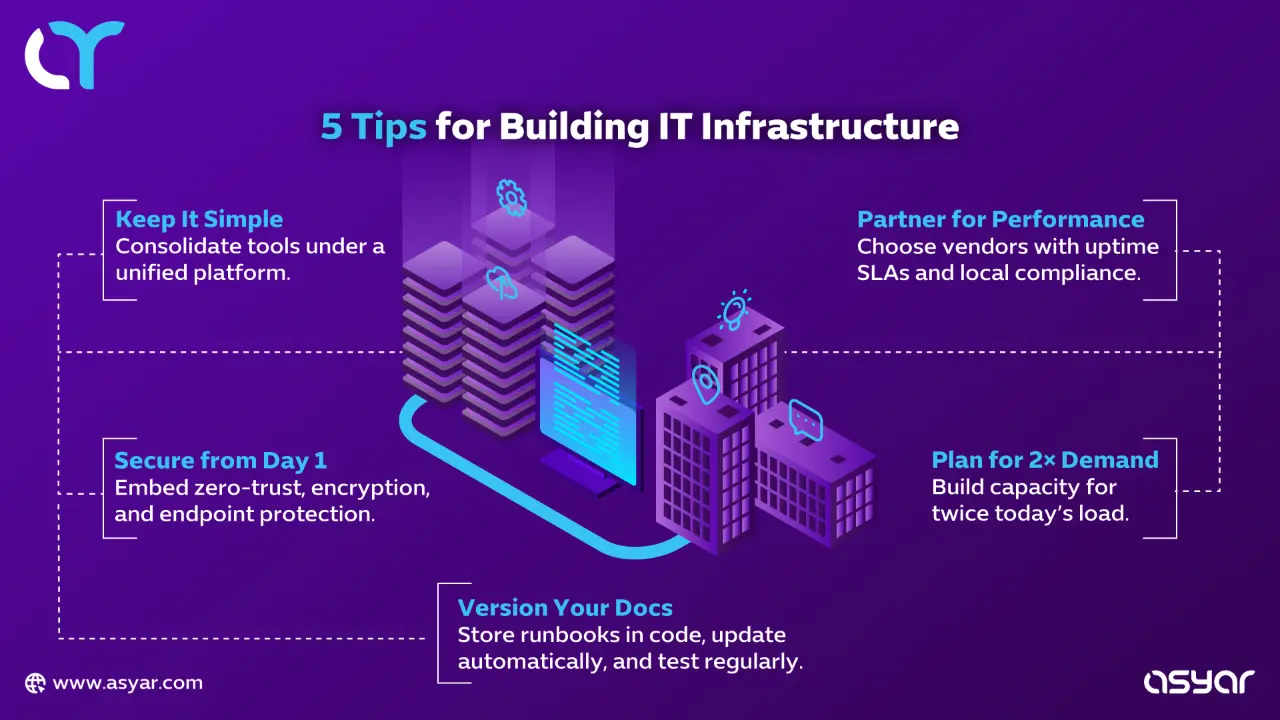
Next up: the 5 Tips for Building IT Infrastructure from Scratch will show you exactly how to turn these avoidable mistakes into strengths.
5 Tips for Building IT Infrastructure from Scratch
Why Choose Asyar for Your IT Infrastructure Build?
When building IT infrastructure from scratch, your choices are as strategic as they are technical. That’s why, from day one, Asyar works hand-in-hand with your team to ensure every design decision drives your business goals and reflects Saudi Vision 2030.
As you grow, we continually refine your architecture, delivering a resilient, compliant foundation underpinned by our local expertise and complete SDAIA/NCA alignment.
Ready to build a reliable IT infrastructure? Contact Asyar today.
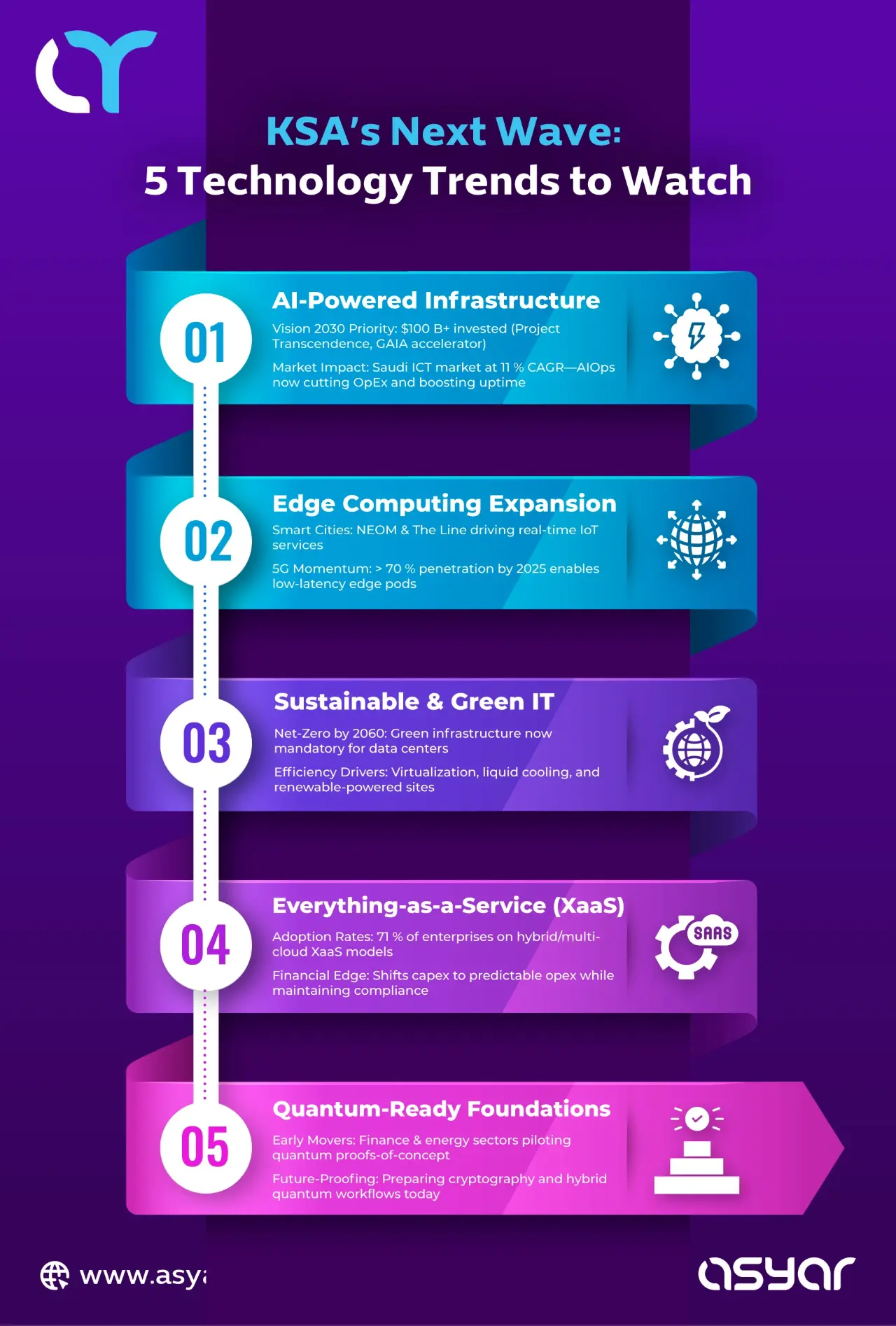
The Future of IT Infrastructure: Emerging Trends to Watch
Building IT infrastructure from scratch in Saudi Arabia means planning for tomorrow’s technologies today. As Vision 2030 drives digital transformation, keep these five trends firmly at the forefront of your focus:
How Can We Help You?
From strategic planning and vendor procurement to design oversight and ongoing vendor coordination, Asyar guides your IT build. We don’t just supply hardware and software; we act as your trusted advisor, ensuring your infrastructure solutions scale seamlessly with your business.
Learn more about our services.
Core Components of a Robust IT Infrastructure
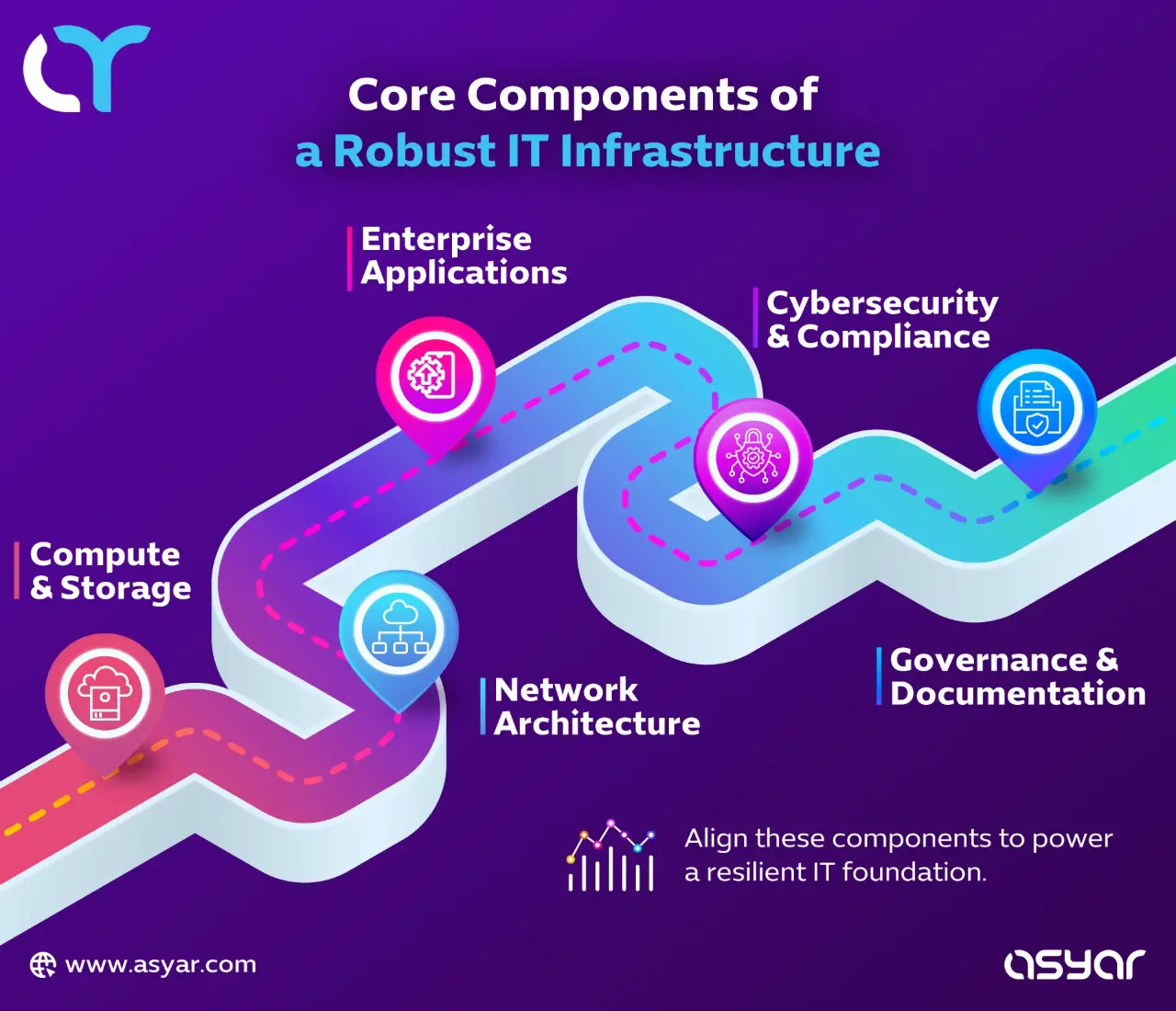
Ensuring operational reliability, regulatory compliance, and future scalability is crucial when building IT infrastructure from scratch in Saudi Arabia.
Below are the primary components of a solid IT infrastructure.
Compute & Storage
Foundation for your digital services: mixed on-premise and cloud capacity sized for growth, high availability, and disaster readiness.
Network Architecture
High-speed, resilient connectivity across sites and remote users to power e-services, IoT, and 5G initiatives.
Enterprise Applications
Integrated ERP, CRM, and collaboration platforms that drive productivity, data consistency, and faster decision-making.
Cybersecurity & Compliance
Built-in defenses (firewalls, encryption, endpoint protection) mapped to NCA/SDAIA standards and continuous monitoring to safeguard data and reputation.
Governance & Documentation
Clear policies, version-controlled runbooks, and formal change processes to ensure audit readiness and rapid incident recovery.
Common Challenges in Building IT Infrastructure & How to Overcome Them
There are particular difficulties when constructing IT infrastructure from the ground up in Saudi Arabia.
The following are the most common obstacles and expert-backed strategies to overcome them:
High Initial Costs & Budget Management
Challenge: Substantial upfront investment in modern, scalable infrastructure can strain budgets, especially for SMEs and fast-growing firms.
Solution:
Adopt cloud-based and XaaS (Everything-as-a-Service) models to shift CapEx into predictable OpEx.
Regularly audit IT spending and leverage leasing or pay-as-you-go plans to optimize resource allocation.
Integration with Legacy Systems
Challenge: Critical legacy platforms often resist modernization and integration with new technologies.
Solution:
Conduct thorough system assessments and map an incremental modernization roadmap.
Use middleware or service-oriented architecture (SOA) to bridge old and new systems without major disruptions.
Partner with vendors who bring local expertise and proven migration frameworks.
Cybersecurity Risks & Data Protection
Challenge: Escalating cyberthreats and outdated infrastructure increase vulnerabilities, and NCA/SDAIA compliance is mandatory.
Solution:
Embed security by design: firewalls, end-to-end encryption, and endpoint protection from Day1.
Schedule regular system updates, audits, and staff training on best practices.
Work with providers who guarantee adherence to Saudi regulatory standards.
Scalability & Future-Proofing
Challenge: Infrastructure must meet today’s needs and flex for rapid growth and emerging technologies.
Solution:
Leverage cloud, virtualization, and modular data centers for scaling.
Design adaptive network architectures and continuously refine capacity-planning processes.
Talent Shortage & Skill Gaps
Challenge: A shortage of skilled IT professionals, especially in AI, cloud, and cybersecurity, can slow project progress.
Solution:
Invest in ongoing training, upskilling, and certification for your team.
Partner with managed-service providers to fill specialized roles and accelerate deployment.
Downtime & Business Continuity Planning (BCP)
Challenge: Unplanned outages inflict financial losses and reputational damage, particularly in regulated sectors.
Solution:
Develop a comprehensive BCP and disaster-recovery plan with regular backups and failover tests.
Choose vendors offering proactive monitoring and rapid response to minimize downtime.
FAQ
Frequently Asked Questions
Find answers to common questions about our services.
Ready to Build a Future-Ready IT Infrastructure?
Partner with Asyar to design secure, scalable, and AI-ready infrastructure aligned with Saudi Vision 2030. Start building smarter, from day one.