
How Businesses Use Artificial Intelligence in Saudi Arabia
Discover how Saudi businesses are using AI to improve efficiency, personalize customer experiences, and drive growth in line with Vision 2030.
Asyar-team
In the next five years, Saudi businesses that fail to adopt artificial intelligence (AI) risk falling behind more agile, tech-driven competitors.
From NEOM’s smart city initiatives to major Saudi retailers’ personalizing customer experiences, high-performing Saudi companies are already leveraging AI to raise quality standards, cut costs, and accelerate innovation.
As such, to stay ahead, companies need to look beyond the decision of whether to adopt AI and focus on how to apply it in ways that strengthen market position and secure long-term competitiveness. That’s especially in a market where margins are tight, competition is intense, and customers expect nothing less than excellence.
This article explores how Saudi businesses can harness AI effectively, and what it takes to turn adoption into a true competitive advantage.
What Is Artificial Intelligence (AI) in Business?
How Do Businesses Use Artificial Intelligence today? At its core, it refers to the use of advanced algorithms and machine learning models to analyze data, automate processes, and support decision-making in ways that drive efficiency, innovation, and growth.
Rather than replacing human judgment, AI acts as an enabler, helping companies scale operations, reduce costs, and uncover new opportunities.
In Saudi Arabia, businesses are increasingly turning to AI as a strategic tool to align with the Kingdom’s Vision 2030 digital transformation goals.
PwC forecasts that AI will contribute 12.4% to Saudi Arabia’s GDP by 2030, one of the highest shares in the region. Yet, despite the promise, leaders must be wary of the AI hype. Initiatives driven by flashy features without strategic alignment rarely deliver meaningful ROI, if they make it past the pilot stage at all.
That’s why AI enablement in business goes beyond technology adoption. It’s a deliberate, strategic process shaped by organizational readiness, clear business goals, and the resources available to achieve them.
To truly answer the question of How Do Businesses Use Artificial Intelligence, we need to look at the real benefits it brings: efficiency, personalization, agility…
Benefits of Using AI in Business
To truly answer the question of How Do Businesses Use Artificial Intelligence, we need to look at the real benefits it brings: efficiency, personalization, agility
AI helps companies cut through complexity. Instead of simply working harder, organizations can work smarter, streamlining operations, strengthening customer relationships, and building resilience for long-term growth.
Let’s break down the key benefits AI brings to businesses today:
Increased Operational Efficiency
AI minimizes wasted effort by automating routine tasks and accelerating insights. This frees teams to focus on high-value work, reducing delays and overhead costs.
Enhanced Customer Experience
By learning from customer behavior, AI personalizes every interaction, whether through smarter chatbots, targeted recommendations, or seamless support that feels human.
Improved Employee Engagement
AI isn’t just about machines; it also improves how people work. Personalized training, adaptive learning paths, and sentiment analysis tools give leaders the visibility to nurture happier, more motivated teams.
Higher Agility & Adaptability
Markets change fast. AI enables organizations to adapt quickly, with real-time analytics, forecasting, and scenario modeling that support faster, more confident decision-making.
Secured Sustainable Growth
Beyond quick wins, AI supports long-term resilience. From predictive risk management to smarter resource allocation, it ensures companies scale efficiently, remain compliant, and stay future-ready.
Challenges for Utilizing AI in the Business World
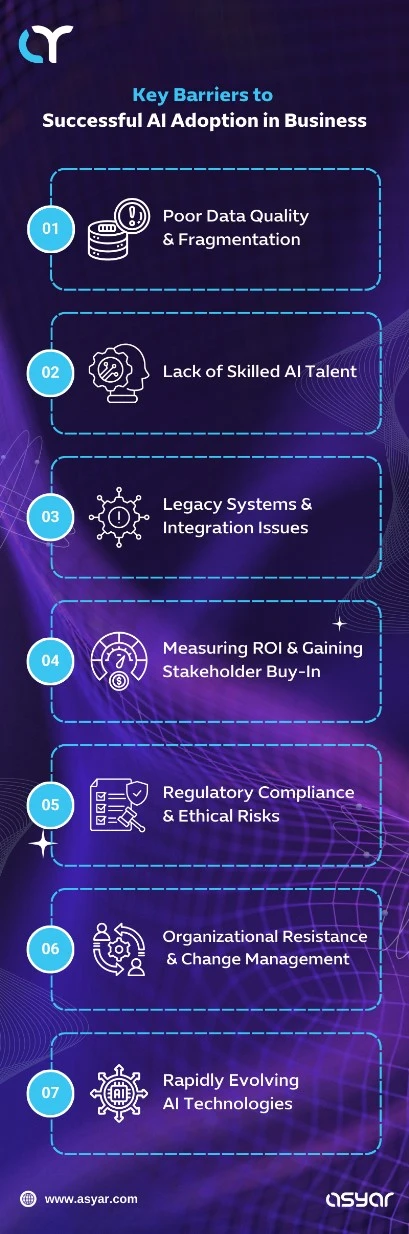
Understanding How Do Businesses Use Artificial Intelligence also means recognizing the barriers: such as poor data, legacy systems, and compliance risks.
AI Challenges Defeat with Asyar
Overcoming Challenges in AI Implementation
As seen above, AI adoption comes with its fair share of hurdles, from data fragmentation to skills gaps. But these challenges can be tackled strategically.
Here’s how businesses can address common obstacles and make AI work effectively.
Data Quality and Fragmentation
Implement strict data validation and integrate data silos using automated pipelines. Clean, unified data is essential for AI to perform reliably.
Talent Shortage
Close skill gaps quickly by upskilling key staff and outsourcing complex AI tasks to experienced specialists. Early progress is often more valuable than perfect execution.
Legacy Systems
Decouple AI from outdated systems using APIs and cloud-first approaches. Focus on flexible, scalable infrastructure that supports future AI growth.
ROI and Buy-In
Start with small pilots, demonstrate measurable impact, and quantify business value. Stakeholders respond to proven results, not theoretical promises.
Compliance and Ethics
Incorporate compliance from the start by designing transparent AI models, auditing regularly, and maintaining fairness to prevent costly legal or reputational issues.
Resistance to Change
Communicate clearly how AI enhances human capability and deliver quick wins to build confidence and momentum among teams.
Fast-Moving Tech
Maintain agility by testing emerging tools continuously and adopting modular architectures to pivot quickly without major system overhauls.
What Are 5 Uses of AI?
AI is no longer a futuristic concept. It’s already solving real problems and adding value in practical ways.
Here are 5 key uses:
1- Analyzing data and generating actionable insights
With data volumes growing at an unprecedented rate, AI-powered analytics help businesses in banking, retail, manufacturing, and beyond extract maximum value and uncover trends that inform smarter decisions.
2- Personalizing customer experience
Beyond chatbots, AI adapts to individual customer profiles, speeding up interactions with instant replies, anticipating needs, and boosting satisfaction through highly tailored experiences.
3- Automating and streamlining business processes
AI goes beyond simple automation by reimagining workflows. From processing invoices to managing supply chains, it eliminates repetitive tasks, reduces operational costs, and increases accuracy, freeing up employees to focus on innovation and high-value work.
4- Ensuring regulation compliance and safer risk management
AI simplifies compliance and risk management by automatically monitoring transactions, flagging potential fraud, generating reports, and ensuring regulatory adherence. This makes businesses more agile in facing financial, legal, and reputational risks.
5- Smarter maintenance planning with predictive maintenance
Instead of reacting to breakdowns, AI predicts when equipment is likely to fail. By analyzing data from sensors and historical performance, it enables smarter maintenance schedules that reduce downtime, extend equipment lifespan, and optimize resource allocation, helping companies save significant costs in the long run.
How Can Businesses Use Artificial Intelligence?
Start Your AI Journey
AI in Business Use Cases
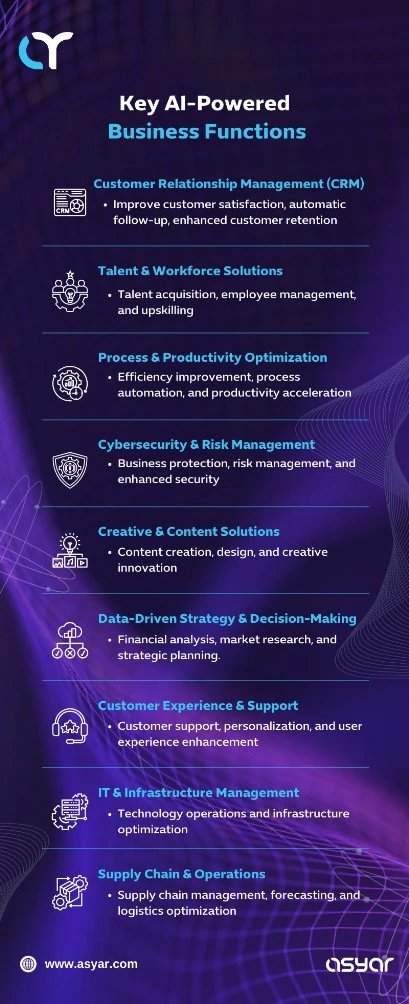
The most practical way to see How Do Businesses Use Artificial Intelligence is by looking at real use cases—chatbots, predictive maintenance, and risk management—where AI turns from theory into real business impact.
Chatbots and Virtual Assistants
What they are: AI-powered agents (chat/voice) that handle routine queries and tasks, escalating complex issues to humans.
Benefits:
Provide 24/7, personalized customer assistance at scale.
Lower support costs and free human agents for higher-value work.
Reduce response times and enhance customer satisfaction.
Challenges:
Require sophisticated natural language processing (NLP) to accurately understand diverse customer intents.
Must integrate cleanly with existing CRM/OPS systems to be effective.
Depend on high-quality training data and bias controls.
Sales and Marketing Personalization
What it is: Using AI to tailor messages, offers, timing, and channels to each prospect or customer.
Benefits:
Lifts conversion and key metrics with AI-driven lead scoring and personalized product recommendations.
Improves campaign performance via real-time behavioral feedback loops.
Increase sales team efficiency by automating customer follow-up and next-best actions.
Challenges:
Data privacy rules constrain data use and personalization depth.
Energy- and labor-intensive models require continuous tuning to stay relevant.
Strong results depend on unified, high-quality data across touchpoints.
Supply Chain Optimization
What it is: Applying AI to forecast demand, plan inventory, and optimize routing and logistics.
Benefits:
Reduces inventory costs and stockouts with more accurate demand forecasts.
Cuts delivery times and fuel costs through AI-optimized routing.
Challenges:
Require change management to adopt AI-driven workflows.
Data silos and inconsistent data formats degrade analytics accuracy.
Predictive Maintenance
What it is: Using AI to predict equipment failures and schedule maintenance proactively.
Benefits:
Minimizes downtime and maintenance costs with data-driven scheduling.
Extends asset lifespan and improves operational safety.
Challenges:
Model accuracy hinges on rich sensor data and reliable history.
Upfront IoT instrumentation and AI expertise can be costly.
Finance and Risk Management
What it is: Leveraging AI for fraud detection, risk assessment, and automated compliance monitoring.
Benefits:
Automates fraud detection with real-time transaction monitoring.
Streamlines regulatory compliance via automated reporting and alerts.
Challenges:
Sensitive financial data demands strict security and governance.
Algorithmic bias can affect decision fairness and regulatory standing.
10 Examples of AI Being Used to Support Business Needs
Transform your Business with the Power of AI
From what we’ve discussed above, it becomes evident that AI isn’t a “trend” or “buzzword”. When implemented correctly, it’s a practical tool that reshapes how businesses operate every day.
However, the keyword here is correctly—transformation doesn’t happen automatically once an AI tool is deployed. That’s because the same technology that enables growth also introduces challenges such as data compliance, skills shortages, integration issues, and cultural resistance. In fact, according to research by Harvard Business Review, nearly 80% of AI projects never reach full deployment.
This gap between potential and reality is where strategy becomes critical. When an AI adoption initiative is not strategic, navigating these challenges becomes nearly impossible.
This is why many Saudi businesses are partnering with AI enablement companies, like our team at Asyar, to design the right approach, overcome barriers, and ensure their investments in AI deliver measurable value.
Businesses That Are Using AI & How
AI is no longer limited to tech giants—it’s shaping industries across the board. Here’s how different sectors are putting it to work:
Healthcare
AI supports faster, more accurate diagnoses and predictive analytics, helping doctors reduce errors, personalize treatments, and improve patient outcomes.
Banking
AI-powered chatbots handle routine customer queries, while fraud detection systems monitor transactions in real time to increase security, speed, and satisfaction.
Postal Services
Route optimization algorithms and automated package sorting allow faster deliveries and lower operational costs.
Manufacturing
Predictive maintenance powered by AI reduces machine downtime, while smart automation increases production efficiency and cuts waste.
Retail
From demand forecasting to personalized recommendations, AI helps retailers streamline inventory management and drive higher sales conversions.
Hospitality
Hotels use AI to personalize guest experiences, offering tailored recommendations and seamless services that boost satisfaction and loyalty.
Technology
AI accelerates software development cycles through automated coding, testing, and debugging, enabling faster innovation and higher-quality products.
Education
Adaptive learning platforms and AI tutoring systems adjust to student needs, improving engagement and learning outcomes.
Social Media
AI filters harmful content and powers highly targeted ads, helping platforms improve safety, retention, and advertising effectiveness.
Logistics and Supply Chain
AI-driven tracking and demand forecasting enhance inventory accuracy, cut delays, and reduce shipping costs.
How Is AI Used in Business Intelligence?
AI is transforming traditional business intelligence (BI) from descriptive reporting into predictive and prescriptive systems. Instead of just showing what happened, AI-powered BI helps organizations anticipate trends, uncover hidden patterns, and make proactive, strategic decisions.
Organizations apply AI in BI in several ways:
Augmented Analytics
Speeds up analysis and highlights actionable insights.
Automates data preparation for faster, more accurate reporting.
Generates insights in real time to support timely decisions.
Machine Learning & Predictive Modeling
Uncovers complex patterns hidden in large datasets.
Predicts future trends to guide strategic planning.
Identifies emerging risks before they impact the business.
Democratization of BI
Makes data accessible to non-technical users.
Reduces reliance on specialized analysts.
Eliminates data silos and improves team collaboration.
Generative BI & Conversational Interfaces
Automates report generation and insight extraction.
Enables natural language querying for intuitive data interaction.
Enhances overall business efficiency by simplifying data workflows.
With AI embedded into BI workflows, businesses gain agility, foresight, and a powerful competitive edge in fast-moving markets.
The Latest AI Trends, Brought to You by Asyar Experts
As you see, AI continues to reshape industries by driving smarter workflows, enhanced creativity, and faster insights. With every new development, the answer to the million-dollar question—“How do businesses use artificial intelligence?”—keeps evolving.
As such, keeping up with AI trends isn’t just interesting; it’s essential. Companies that adapt quickly stay ahead of competitors and are better prepared for the challenges of tomorrow.
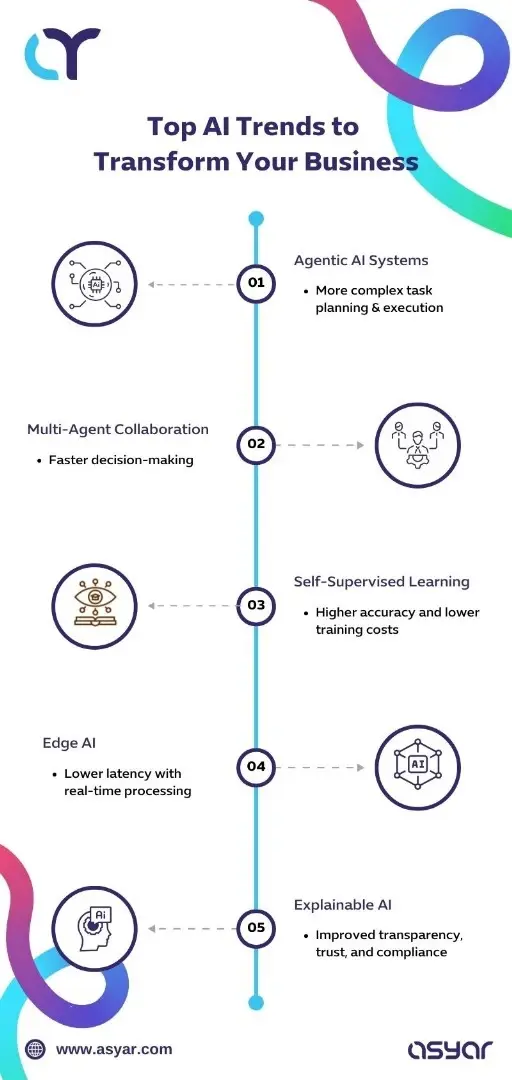
That’s why at Asyar, we don’t only monitor trends on your behalf—we help shape how they’re applied in real business contexts. Our experts stay at the forefront of emerging technologies so we can deliver solutions that give our clients a lasting competitive edge.
If you’re curious to see what that looks like in action, contact us today for a demo and discover how our tailored AI solutions can help your business lead the way.
How to Use AI for Corporates Effectively
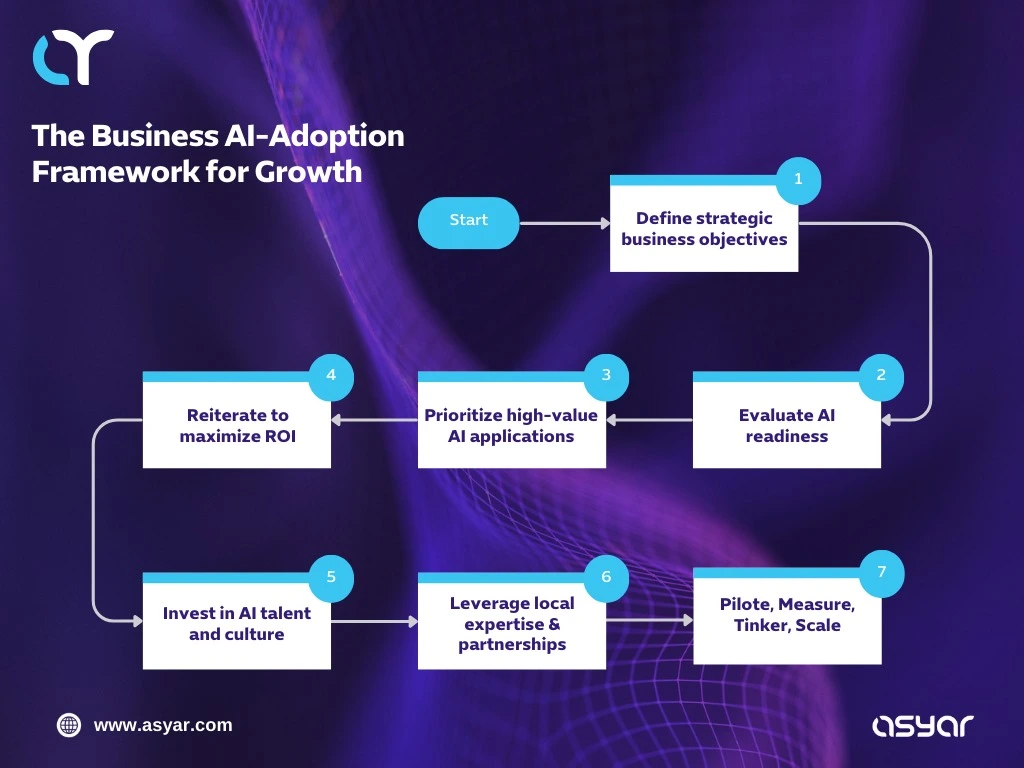
Speaking of trends, adopting AI isn’t just about deploying the latest tools. It’s about aligning them with strategy, people, and processes. Here are key practices we recommend based on our years of experience in the Saudi market:
1- Invest Heavily in Data Quality and Governance
Maintain accurate, clean, and well-structured data. Reliable data allows AI to generate actionable insights and reduces the risks of flawed decisions or compliance issues.
2- Build Cross-Functional Teams and Foster an AI-Ready Culture
Combine business leaders, domain experts, and AI specialists. Promote collaboration and upskilling to create an environment that embraces AI adoption and experimentation.
3- Start Small With Scalable Pilots
Focus on high-impact, low-risk initiatives first. Pilots help validate assumptions, demonstrate ROI, and provide learnings before scaling AI solutions organization-wide.
4- Implement Continuous Monitoring and Agile Transformation
Track AI performance and adapt quickly. Agile workflows allow for iterative improvements, keeping models aligned with changing business goals and market conditions.
5- Use AI to Augment Human Expertise, Not Replace
Leverage AI to handle repetitive or data-intensive tasks, freeing teams to focus on creative problem-solving, strategic decisions, and innovation-driven work.
How Do Businesses Use Artificial Intelligence with AI Enablement Companies?
Adopting AI can be transformative, but it’s also complex. Many Saudi businesses partner with AI enablement companies to navigate this complexity and turn potential into real, measurable results.
These partners bring deep industry expertise, hands-on experience, and a structured approach that helps businesses overcome challenges like skill gaps, fragmented data, legacy systems, and integration hurdles. By working with experts, companies can focus on strategy and growth while AI adoption is executed effectively and efficiently.
At Asyar, we don’t just implement AI tools; we tailor solutions to your industry, resources, and goals. Our proven frameworks are designed to guide you through each step, from identifying high-value opportunities to scaling solutions across your organization. We combine technology with strategy, ensuring that AI supports your long-term objectives rather than creating new complications.
If you’re still asking yourself How Do Businesses Use Artificial Intelligence to stay competitive, the answer lies in strategic adoption supported by the right partners.
FAQ
Frequently Asked Questions
Find answers to common questions about our services.