
Saudi Digital Transformation and Vision 2030: What CIOs Should Be Planning for Now
Saudi digital transformation is moving fast under Vision 2030. Here are the four priorities CIOs should plan around next, so national momentum becomes results.
Asyar-team

You're making progress with your organization's digital transformation strategy. It lines up with Vision 2030 and the Kingdom's strides in AI and the digital economy. But proving the return on that work is a separate problem.
Can you show it in revenue gained, cost avoided, or risk reduced?
This question is getting harder to avoid. Saudi digital transformation is setting a strong and continually rising national benchmark, and your results now sit against it.
For the second year in a row, Saudi Arabia ranked first of 159 countries in the International Telecommunication Union's 2026 ICT Development Index. The digital economy reached 16.0% of GDP in 2024, up from 15.6% in 2023.
In this article, we'll look at where Saudi Arabia's digital economy stands under Vision 2030, and the four priorities CIOs should plan around now.
Saudi Arabia's Digital Economy Under Vision 2030
The national picture is straightforward. The foundations are built, and the spending behind them keeps growing.
More than 97% of government services are digitized. Saudi Arabia ranked sixth globally in the UN E-Government Development Index in 2024, and first in the Middle East and North Africa (MENA) region for digital government services for four years running.
By the end of 2025, the Kingdom's ICT market had reached SAR 199 billion ($53 billion). That's a compound annual growth rate (CAGR) of 8% over five years, making it the largest and fastest-growing ICT market in MENA.
Government spending shows where that momentum is heading. In 2025, government bodies spent SAR 31.9 billion ($8.5 billion) on ICT and IT services across more than 6,145 contracts. Spending on AI and emerging technologies rose 20% against 2024. Cloud computing spending rose 42%.
For CIOs, Saudi digital transformation changes what counts as a credible plan. National readiness and connectivity are no longer the limiting factors.
Further reading: 31 Digital Transformation Statistics for Saudi Arabia
Where Does Saudi Digital Transformation Stall Inside Organizations?
Meeting digital transformation requirements does not automatically make an organization a digital leader.
For a CIO at a Saudi enterprise or startup, the stall has a familiar shape. Projects get shipped and systems get modernized. Then someone asks what changed as a result. The answer is usually a list of deliverables.
Saudi Arabia has no public maturity index for private companies. The closest measure covers government entities. If you work in one, this is your scorecard. If you don't, it's still the clearest local read on where digital programs stall.
Across 240 government entities in the 2025 cycle, the Digital Transformation Index averaged 88.30%, up from 87.14% the year before. Only 26 reached the innovation level, the top tier.
These organizations had a national mandate and rising budgets behind them. They were measured against 95 criteria. Most cleared the requirements. Few turned that into what the index recognizes as innovation.
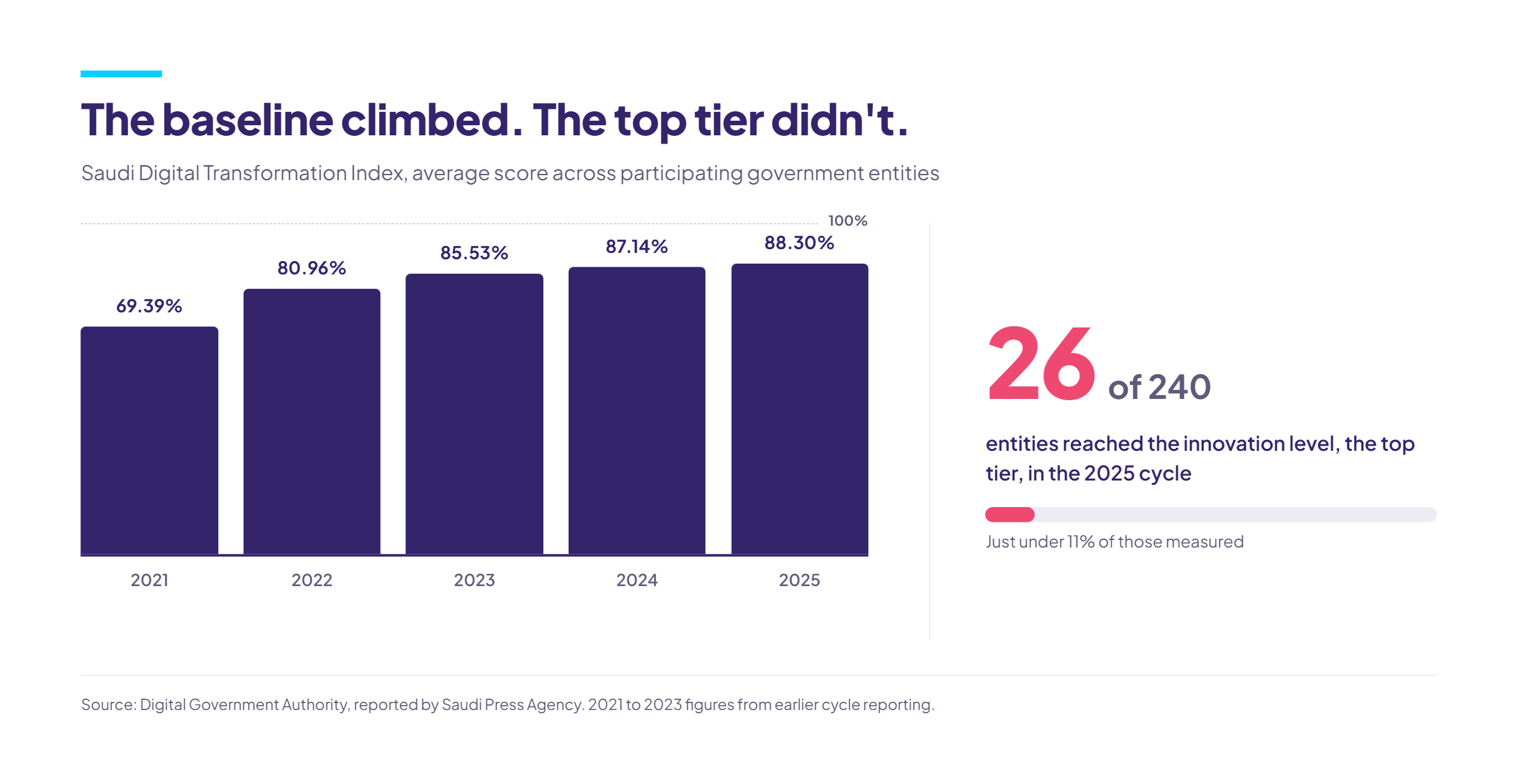
That gap doesn't come from budget or mandate. Both were present. It comes from the difference between completing a program and changing how the organization works.
Compliance scores have a second limit. A percentage tells you a process was followed. It doesn't tell you what the spend returned.
So the gap isn't in the infrastructure or the standards. It's in what runs on top of them. It's in who owns the outcome, and whether anyone can trace a result back to the investment.
Further reading: AI Enablement in Saudi Arabia: Strategy, Challenges & Growth
Four Digital Transformation Priorities for Saudi CIOs Right Now
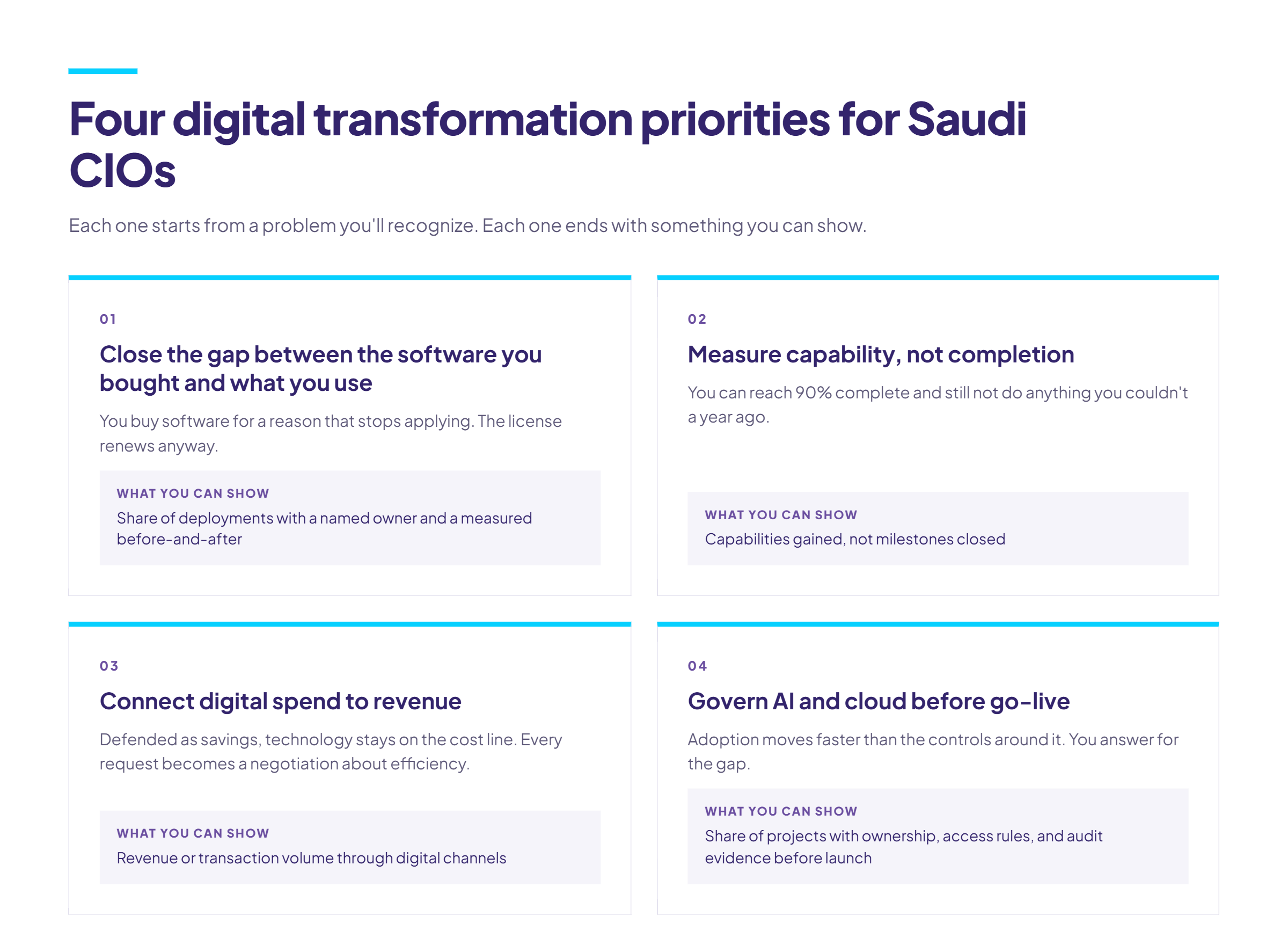
Each of the four priorities below starts from a problem you’ll recognize. Each of them ends with something you could put in front of the person asking about ROI.
Close the gap between the software you bought and what you use
If you're operating in Saudi Arabia, your infrastructure is unlikely to be the constraint. The Kingdom's global rankings settled that.
You buy software for a reason that holds at the time. Then the reason changes. The tool doesn't do what the demo suggested, or you shift priorities two quarters later. The license renews anyway.
So the first move is to check what you and your team are running. Ask whether you still need it, and who owns the result.
What you spend next belongs on top of your infrastructure. That means automating approvals and reporting, putting AI into document-heavy processes, and giving teams data without filing a request.
What you can show: the share of your recent deployments with a named owner and a measured before-and-after.
Further reading: 14 IT Infrastructure Statistics for Saudi Arabia: Global & Regional Benchmarks
Measure capability, not completion
Your quarterly update likely leads with a completion figure, one that climbs every month or quarter. But you can reach 90% and still not do anything you couldn’t a year ago.
The gap shows when something new lands. A regulator changes a requirement, or a competitor ships a service you can’t match. The roadmap says you’re finished. The organization still can’t do the thing.
So change the question you ask each quarter. Measure what the organization can do now that it couldn’t before the program started. Then name what it still can’t do.
What you can show: capabilities gained, not milestones closed.
Connect digital spend to revenue
You defend technology spending as cost savings, because savings are easily approved. This framing has a ceiling. Once technology sits on the cost line, every request turns into a negotiation about efficiency.
Saudi growth figures point somewhere else. The e-commerce sales index rose 9.8% year on year in Q2 2026, while retail trade rose 13.4%.
A digital economy at 16.0% of GDP is not growing on savings alone. Find where your own digital channels bring in revenue or carry service volume, and report that next to the savings.
What you can show: revenue or transaction volume through digital channels, tracked over time.
Further reading: How to Measure Digital Transformation ROI
Govern AI and cloud before you go live
There's a good chance someone in your organization is running an AI tool you didn't approve. It may already hold customer data.
Adoption moves faster than the controls around it. Saudi government spending on AI and emerging technologies rose 20% last year, and cloud spending rose 42%. Governance rarely moves at that rate.
Set ownership, access rules, and audit evidence before deployment. After the first incident, you're explaining rather than deciding.
What you can show: the share of AI and cloud projects with those three in place before launch.
Where Should You Start With Your Own Digital Transformation?
You won’t run all four at once, and you don’t need to. The point is knowing which one you’re weakest on.
Take these four questions into your next leadership meeting, one per priority.
What share of the software you paid for this year is in daily use?
What can your organization do today that it couldn’t before your current program started?
How much revenue or service volume runs through your digital channels?
How many of your AI and cloud projects had an owner, access rules, and audit evidence before launch?
If you can answer all four with numbers, you’re ahead of most. The one you can’t answer is where to start.
Where a decision is already in motion, start there instead. A renewal coming up makes the first question urgent. A pending AI rollout makes the fourth.
Make Saudi Digital Transformation Show Up in Your Numbers
The national numbers will keep climbing. That part isn't in your control.
What you can control is whether your own work shows up in revenue gained, cost avoided, or risk reduced. Pick one of the four priorities and answer it properly this quarter. The other three will still be there.
Asyar’s team brings more than 20 years of combined experience in the Saudi market, across 35+ transformation projects. Delivery is 100% PDPL and NCA compliant. Local regulation shapes the plan from the start rather than arriving late.
Which of the four can you answer today? Book a call with Asyar to turn your answer into a roadmap.
Saudi Digital Transformation and Vision 2030: What CIOs Should Be Planning for Now
Asyar-team